
Product-market fit is one of the most important ideas in startups, but it is often described in the least useful way.
“You’ll know it when you have it.”
“The market pulls the product out of your hands.”
“Everything just starts working.”
There is truth in those phrases. When product-market fit is strong, a company does feel different. Customers come back. Sales conversations get sharper. Word of mouth starts to happen. The roadmap becomes less abstract. The market starts pulling instead of the company pushing every inch of the way.
But for early founders, “you’ll know it when you have it” is not enough.
If product-market fit is the thing every startup is trying to find, we should be more precise about what it actually is. We should be able to map the signals. We should be able to separate real traction from polite feedback, curiosity, founder energy, or one unusually enthusiastic customer.
Product-market fit is the accumulated evidence that a specific market urgently wants what you are building, keeps choosing it, and cares enough to help make it better.
How PMF became the startup holy grail
Every startup begins with a belief.
A belief that something is broken.
A belief that a group of people is underserved.
A belief that the current way of doing things is too slow, too manual, too expensive, too frustrating, or too outdated.
A belief that if you built something better, people would care.
But belief is not product-market fit.
A product is not valuable just because it was hard to build. A feature is not important just because the team is proud of it. A problem is not urgent just because the founder has experienced it personally.
The market has to agree.
That is why product-market fit became such a central idea in startup building. Marc Andreessen famously described product-market fit as being in a good market with a product that can satisfy that market. His deeper point was that the market matters more than founders often want to admit: in a great market, the market pulls product out of the startup; in a weak market, even a strong team and strong product can struggle.
That framing changed the question.
The question is not only:
“Can we build this?”
The better question is:
“Does this market urgently want this?”
Dan Olsen’s The Lean Product Playbook makes this more practical. His Product-Market Fit Pyramid breaks PMF into layers: target customer, underserved needs, value proposition, feature set, and user experience. The important lesson is that the bottom of the pyramid is not the product. It is the market: who the customer is and what need is not being served well enough today.
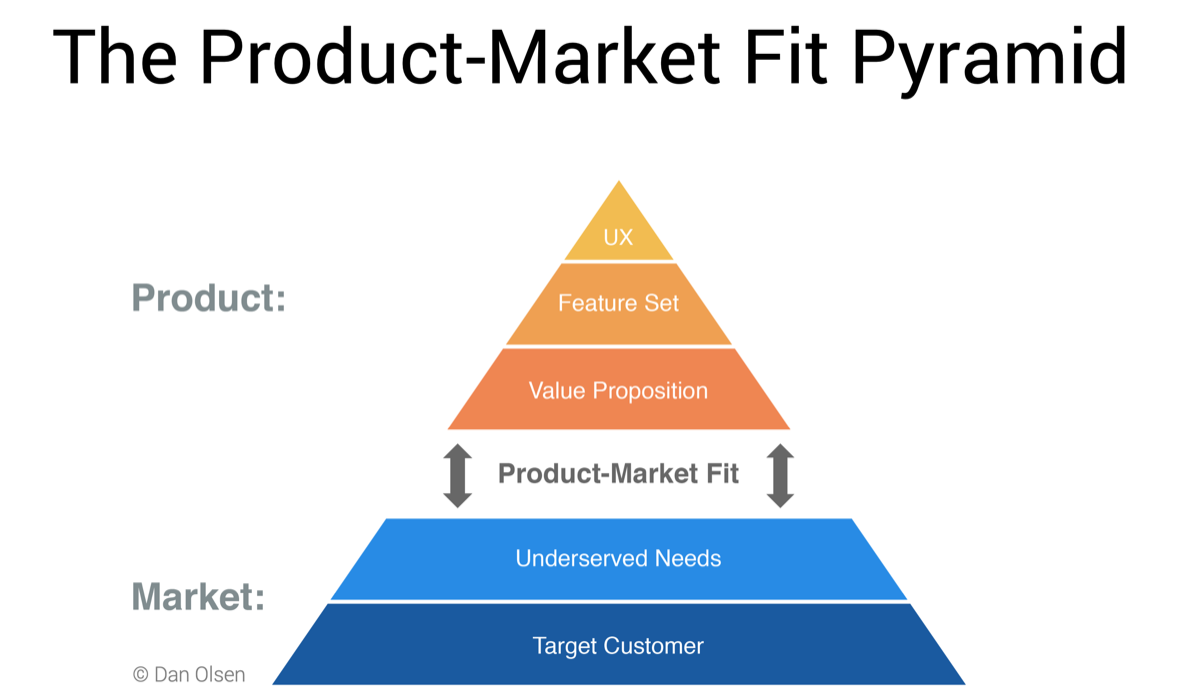
Even if you have an amazing product, if the market isn't ready for it, you will have no sales.
Sean Ellis helped make PMF more measurable through the now well-known Sean Ellis test, a product-market fit survey that asks users how they would feel if they could no longer use the product. The commonly cited benchmark is that if 40% or more of users say they would be “very disappointed,” the company has a strong PMF signal.
That survey matters because it turns something vague into a signal. It does not prove everything by itself, but it moves the conversation from “do people like us?” to “would people actually miss us?”
The problem with treating PMF like a feeling
There are many things that feel like product-market fit but are not product-market fit.
A waitlist can feel like PMF.
A successful launch can feel like PMF.
A great demo can feel like PMF.
Positive investor feedback can feel like PMF.
Friendly beta users can feel like PMF.
A customer saying “this is cool” can feel like PMF.
But the market does not vote with opinions.
It votes with behavior.
Someone being interested is not the same as someone changing how they work. Someone signing up is not the same as someone returning. Someone giving positive feedback is not the same as someone paying, expanding, inviting teammates, or caring when the product changes.
This is one of the hardest parts of building early product: the feedback is noisy.
People are polite.
Users say things they do not mean.
Prospects ask for features they may never use.
The loudest feedback is not always the most important feedback.
One excited customer can make a weak signal look stronger than it is.
That does not mean you should ignore early enthusiasm. It means you need to understand what kind of signal you are looking at.
Interest means someone is curious.
Engagement means someone is trying.
Retention means someone is getting value.
Willingness to pay means the value is real enough to trade money, budget, time, or internal political capital for it.
Product-market fit is not when people understand your product. Product-market fit is when the right people repeatedly choose it.
That distinction matters because building a startup is emotionally expensive. Founders naturally look for proof that the work is working. A positive call feels good. A signup feels good. A user saying “I love the idea” feels good.
But PMF is not proven by encouragement.
It is proven by repeated behavior from the same type of customer.
What PMF actually looks like in the data
Product-market fit is not one metric. It is a pattern of signals.
No single dashboard can tell the whole story. No single survey response can prove it. No single customer conversation can confirm it. But when the right signals start pointing in the same direction, you can see the market beginning to fit around the product.
The first signal is retention.
Do people come back after the first moment of curiosity? Does usage survive once the founder stops hand-holding the account? Does the product become part of a recurring workflow?
For B2B companies, this matters even more. It is easy to get someone to try a tool once. It is much harder to become part of how a person or team actually works. Retention is the market saying, “This is still useful after the novelty is gone.”
The second signal is pull.
Pull is what people usually mean when they say “you can feel PMF.” But it should not stay abstract.
Pull looks like users asking when something is shipping. It looks like customers complaining when something breaks. It looks like teammates being invited into the product. It looks like users following up without being chased. It looks like people describing your product to someone else because the problem is common enough and painful enough to share.
Pull is demand becoming visible.
The third signal is urgency.
A customer can understand your product and still not care enough to adopt it. This is where many products get stuck. The problem is real, but not painful enough. The product is useful, but not necessary. The workflow is annoying, but not urgent.
Urgency shows up when the current workaround is expensive, slow, embarrassing, risky, or repeated often enough that doing nothing has a cost.
The fourth signal is willingness to pay.
In the earliest stages, payment may not be the first signal. Sometimes you are still learning who the customer is, what the workflow looks like, and where the pain is sharpest.
But eventually, PMF has to connect to value capture.
For B2B, willingness to pay is not just “will someone enter a credit card?” It can also mean: will the user introduce the buyer? Will the team go through procurement? Will they convert after the pilot? Will they expand beyond the first use case? Will they spend internal energy to get this adopted?
Money is not the only signal of value, but it is one of the clearest.
The fifth signal is repeatability.
One happy customer is not enough.
Ten happy customers with ten unrelated problems may still not be enough.
The stronger signal is when the same type of customer has the same pain, responds to the same promise, gets value from the same product, and can be reached through a repeatable motion.
This is what investors and experienced operators are often looking for when they talk about PMF. They may describe it emotionally, but they underwrite it through evidence: retention, demand, customer satisfaction, expansion, sales efficiency, and repeatability.
First Round’s B2B PMF framework is useful here because it argues that product-market fit is not binary. It progresses through levels, and the strongest version requires satisfaction, demand, and efficiency. In other words: customers need to be happy, the market needs to want the product, and the company needs to be able to deliver it repeatably without rebuilding the business around every new customer.
That is a much better way to think about PMF.
Not as a magic moment.
As a set of signals getting stronger over time.
The most overlooked PMF signal: customers who already care
When teams think about feedback, they often think about what is broken.
Bugs.
Complaints.
Support tickets.
Confusing flows.
Churn risks.
That feedback matters. If users are blocked, frustrated, or confused, you need to know. Fixing friction protects retention.
But PMF is not only about fixing what is broken.
Some of the best PMF signal comes from customers who already love the product.
That sounds obvious, but it is easy to miss.
When a user does not care about your product, their feedback is often vague. They may not have enough context to know what should be better. They may suggest surface-level improvements. They may disappear before you learn much.
But when a customer already loves the product, their feedback changes.
They are not saying, “I do not get this.”
They are saying, “I want to use this more.”
They are saying, “This is almost perfect for my workflow, but this one part slows me down.”
They are saying, “If this connected to the next step, I could bring in my team.”
They are saying, “This would be much more valuable if I could do this here.”
That is not just bug reporting.
That is product-market fit getting sharper.
The users who care enough to show you what could be better are often showing you where the product can become more embedded, more valuable, and harder to replace.
This is the part of PMF that does not get talked about enough.
PMF is not just proven by users who stay.
It is sharpened by users who care enough to tell you what would make them stay longer.
Our bet: PMF data should come from users in context
Most teams do not lack opinions about product-market fit.
They lack clean signal.
The data is usually scattered everywhere.
Analytics tools show what users did, but not always why they did it.
Sales calls show what prospects said, but not always what happens after they try the product.
Support tickets show what broke, but not always how important the issue is.
Slack threads show what the team remembers, but not always what actually happened.
Surveys show reflection after the fact, but often miss the moment of friction.
The missing layer is contextual user feedback.
What was the user trying to do?
Where did they get stuck?
What did they expect to happen?
What part of the workflow could be better?
How painful was the friction?
Did the same issue show up for similar users?
Did fixing it change behavior?
This is the bet behind Produck.
If product-market fit is measurable, then teams need better ways to collect PMF data where the user actually experiences the product.
Not three weeks later in a survey.
Not buried in a support thread.
Not reconstructed from memory on a customer call.
In the product. In the moment. Attached to the exact thing the user is reacting to.
If a customer can point, scan, highlight, or speak naturally about the part of the product they want to improve, the team gets a different quality of signal. The feedback is no longer just “something felt off.” It becomes: “this part of this workflow could be better, for this type of user, at this moment.”
That matters because the best customers often want to help.
They just need an easier way to show you what they mean.
And when you make that easy, feedback stops being a pile of anecdotes. It becomes a map.
A map of pain.
A map of urgency.
A map of repeated friction.
A map of expansion opportunities.
A map of where the product can become indispensable.
That is how teams should think about PMF.
Not as a vibe.
Not as a single metric.
Not as something you either have or do not have.
But as the accumulation of evidence that a specific market wants your product, keeps choosing it, and is actively showing you how to make it more valuable. Then it's up to you to build what they're asking for.
Capturing that evidence in context is exactly what we're building at Produck. Drop the duck into your app and let your best customers show you, in the moment, where the product can become more valuable. Get early access now.