
Most teams think they have a PMF problem. What they actually have is a loop problem. Signal gets captured, summarized, argued about in a Slack thread, and then it quietly dies before anything ships.
You can see the two failure modes everywhere. Some teams are "data-driven," but are slow to ship. They run surveys, watch session replays, stare at dashboards. Other teams are the opposite: they ship constantly, but decide what to build off hunches, the loudest customer in the room, or whatever a competitor launched last week.
Both teams have the same problem. The loop never closes. Learning doesn't compound, and PMF stays just out of reach.
So let's map what tools businesses currently have to find PMF, and then identify what the market is missing: a system that carries user intelligence all the way through instead of dropping it at every handoff.
The PMF loop
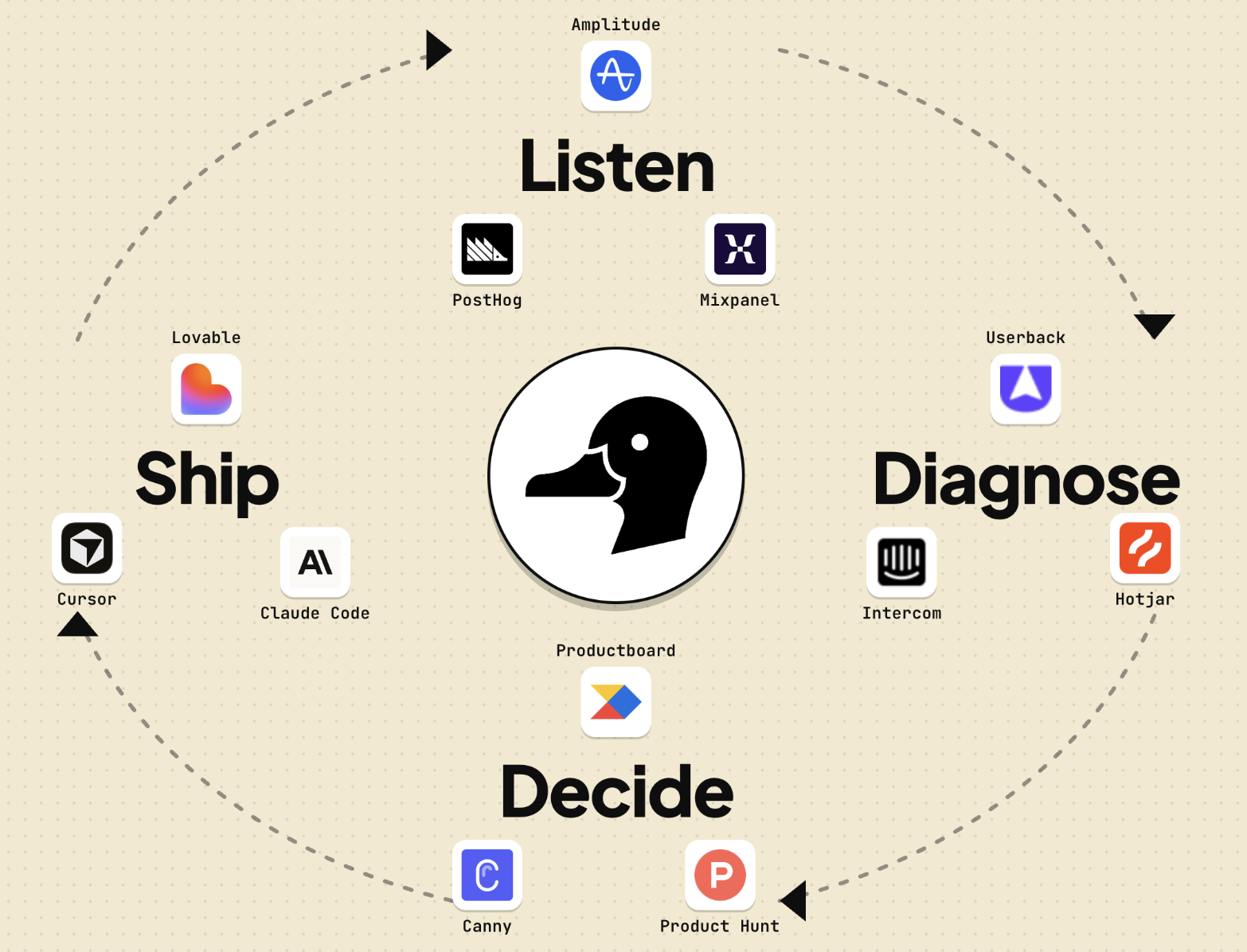
We've identified that there are 4 key stages that help builders achieve product-market fit:
| Stage | Description | Tools |
|---|---|---|
| Listen | Capture raw signal. What users do, what users say. But they capture signal, not meaning. Context leaves the moment; "why" is a guess. | Amplitude, PostHog, Mixpanel |
| Diagnose | Turn that signal into meaning. Themes, causes, segments, severity. But they stop at insight. No bridge to a shipped fix with context attached. | Userback, Intercom, Hotjar |
| Decide | Turn meaning into a ranked plan. What to build next, and why. But weak upstream signal turns "deciding" into politics and vote-counting. | Productboard, Product Hunt, Canny |
| Ship | Deliver the change, measure what moved, feed it back into Listen. But blind to user context. Agents ship whatever you point them at. | Claude Code, Lovable, Cursor |
PMF is what you get when this loop compounds and your users love your product more. Every cycle should make the next one faster and smarter. If it doesn't, you don't have a loop. You have four disconnected tools. Zoom out and the issue isn't that any of these tools are bad; it's just that none of them owns the thing that makes PMF compound.
Where the stack fails
Most teams overinvest in one end (Listen or Ship) and starve the middle (Diagnose and Decide). PMF is a chain. The weakest link sets the ceiling, no matter how strong the rest is.
You probably recognize at least one of these scenarios below.
Survey stack (Listen only). You send NPS surveys, run interviews, dump feedback into a Notion doc. What you end up with is a pile of opinions and no repeatable path from "users said this" to "we shipped that" to "it worked."
Analytics stack (Listen only). You've instrumented everything. PostHog, Amplitude, funnels, drop-offs, the works. You can see exactly what happened. You still don't reliably know why, so prioritization turns into inference and debate.
Roadmap by opinion (Decide without hearing). You're always deciding. New features, a redesign, a rebrand, an expansion. But the inputs are inconsistent: founder gut, one loud prospect, competitor FOMO. Sometimes it works. Mostly it produces churn-shaped surprises three months later.
Execution only (Ship without closure). You're great at clearing tickets and merging PRs. But the work never routes back to user context or outcomes. Ask which change actually moved activation or cut churn and nobody can answer. You're running fast without learning faster.
None of these is an effort problem. They're all the same structural problem: a missing stage, or a missing connection between stages.
The missing layer: user intelligence
Here's the gap. User intelligence is a continuously growing, queryable memory of who said what, in what context, what you shipped in response, and what changed because of it. It keeps meaning attached the whole way from Listen to Diagnose to Decide to Ship.
Plenty of products help you listen. Several help you diagnose. A handful help you decide. Loads help you ship. Almost none keep the intelligence intact across all four, which is exactly why the loop doesn't compound. What most teams call a "PMF stack" is really a set of disconnected optimizers that happen to share a workspace.
What a real PMF loop actually needs:
- Capture high-signal input in context, not post-mortem opinions
- Structure it automatically: dedupe, themes, metadata, severity
- Make it decision-ready so prioritization is fast and grounded
- Carry it into execution without losing meaning, so context survives the ticket and the PR
- Close the loop: measure outcomes, let users feel heard, feed the result into the next cycle
- Keep traceability, so the loop gains memory over time
If a tool only nails one or two of these, it's a point solution. That's fine. Just don't mistake it for a loop. PMF isn't about collecting more feedback or shipping more features. It's about compounding cycles of learning through a tight feedback loop, and your stack can't compound if the loop breaks between stages.
You don't need more tools. You need the whole loop, powered by user intelligence that stays intact end to end.
That missing layer is what we're building at Produck. Drop the duck into your app and improve product-market fit. Get early access now.